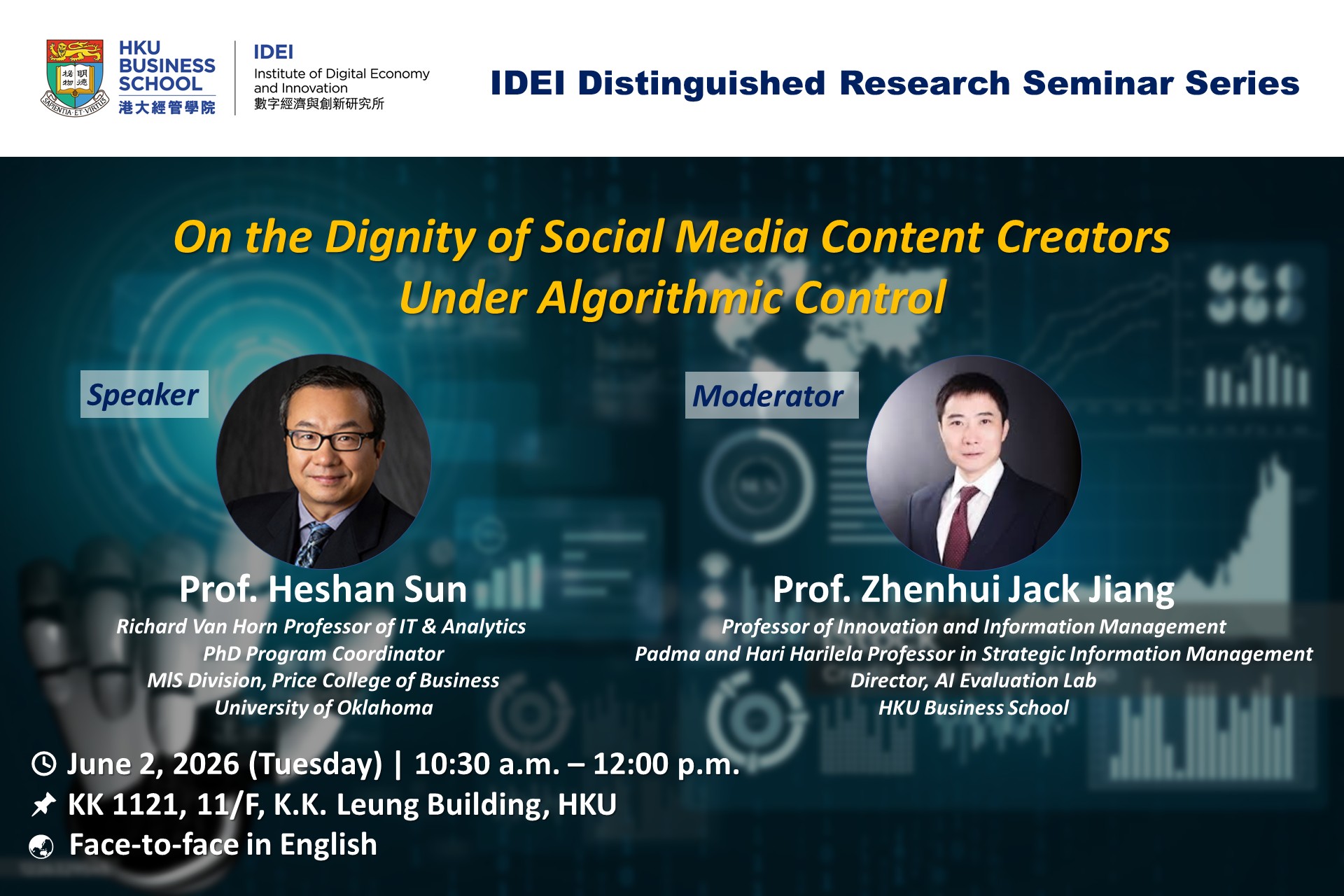
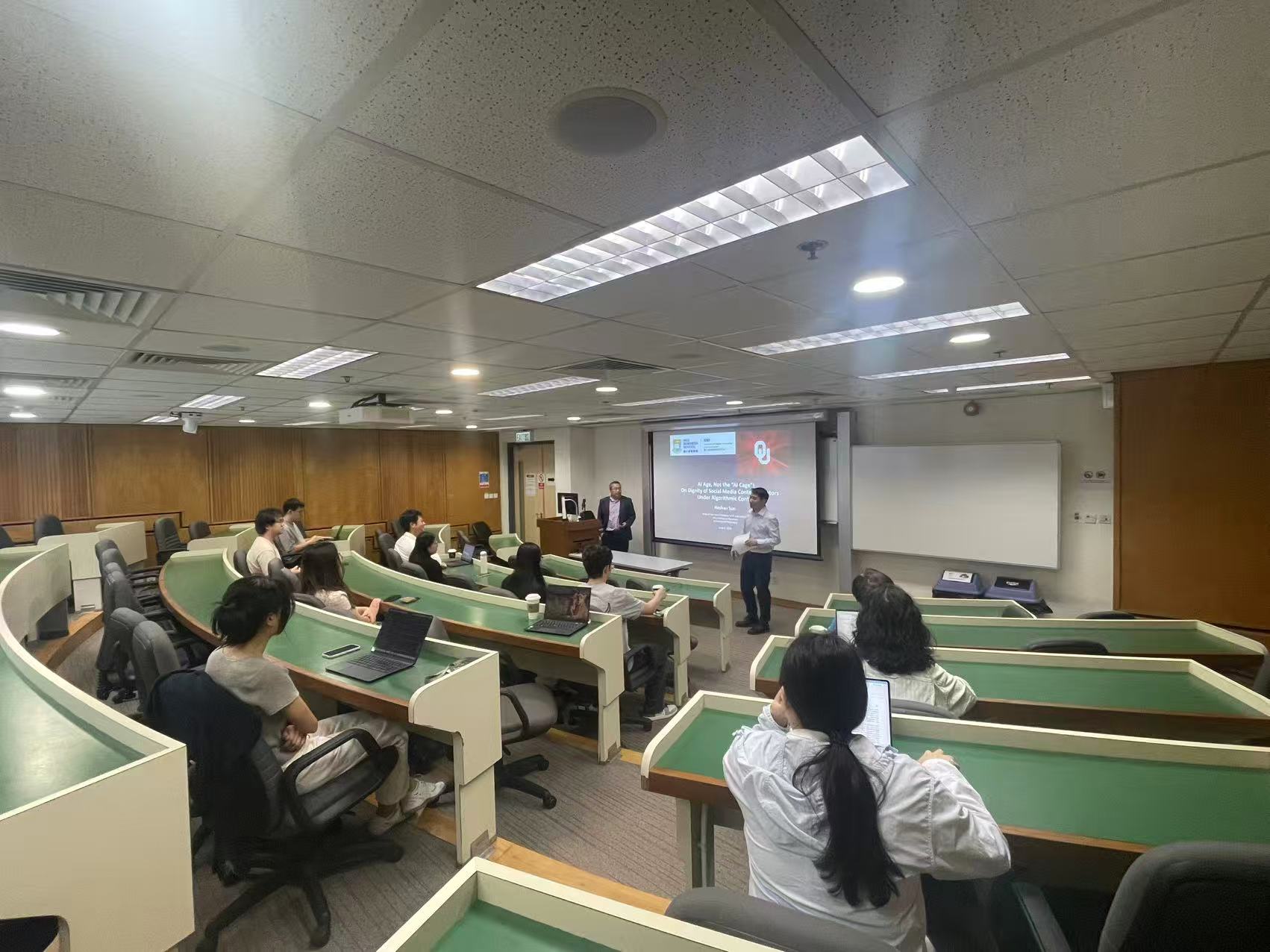
On the Dignity of Social Media Content Creators Under Algorithmic Control
June 2, 2026 | 10:30 a.m. — 12:00 p.m.
KK 1121, 11/F, K.K. Leung Building, HKU
Face-to-face in English
No registration required
SPEAKER
Prof. Heshan Sun
Richard Van Horn Professor of IT & Analytics
PhD Program Coordinator
MlS Division, Price College of Business
University of Oklahoma
SPEAKER
Prof. Heshan Sun
Heshan Sun, Ph.D., is the Richard Van Horn Professor of IT and Analytics in the Management Information Systems Division at the Price College of Business, University of Oklahoma, where he also serves as coordinator of the division’s Ph.D. program. His research examines how information technology profoundly influences and interacts with individuals, organizations, and society. Specifically, his interests include human–technology/AI interaction, business analytics, and online crowd behavior. His published and forthcoming work has appeared in leading academic journals such as MIS Quarterly, Information Systems Research, and Journal of the Association for Information Systems, among others. Dr. Sun is a Senior Editor at MIS Quarterly, Journal of the Association for Information Systems, and AIS Transactions on HCI.
ABSTRACT
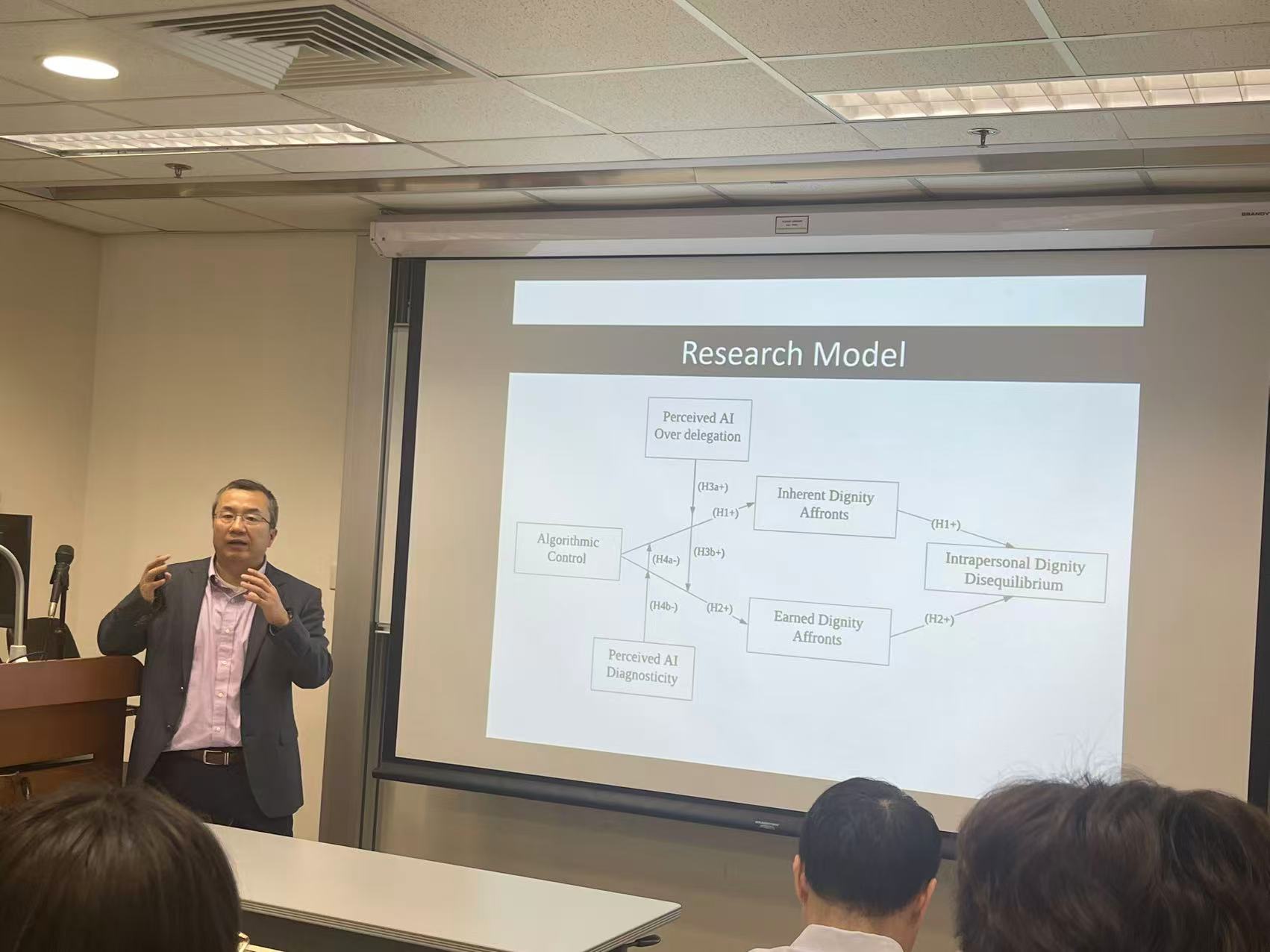
The growing use of algorithmic control in digital platforms raises a fundamental tension between efficiency-oriented governance and human dignity, especially when participation requires the digitization of the self. Drawing on CARE (claims, affronts, response, equilibrium) theory of dignity and recent work on algorithmic control, we develop a mid-range theoretical model that explains how and when algorithmic control impacts social media content creators’ dignity. We theorize two distinct yet interrelated dignity affronts: affronts to inherent dignity, reflecting constraints on moral autonomy, and affronts to earned dignity, reflecting misrecognition of effort and contribution. We further argue that these affronts jointly give rise to intrapersonal dignity disequilibrium, a state of internal tension experienced when participation simultaneously affirms and undermines one’s dignity. Using an online experiment (N=260) conducted on a custom social media platform, our results provide evidence that algorithmic control systematically generates both inherent and earned dignity affronts, and that these affronts jointly give rise to intrapersonal dignity disequilibrium. We further show that content creators’ interpretations of algorithmic control shape the magnitude of these effects: perceived AI over-delegation intensifies inherent dignity affronts but not earned dignity affronts, whereas perceived AI diagnosticity attenuates the effects on both dignity affronts. Together, these findings position algorithmic control as a dignity-relevant form of governance that, while designed to scale participation and increase efficiency, simultaneously constrain the moral conditions under which creators experience autonomy and recognition in digital platforms. The findings from this research have implications for both research and practice.