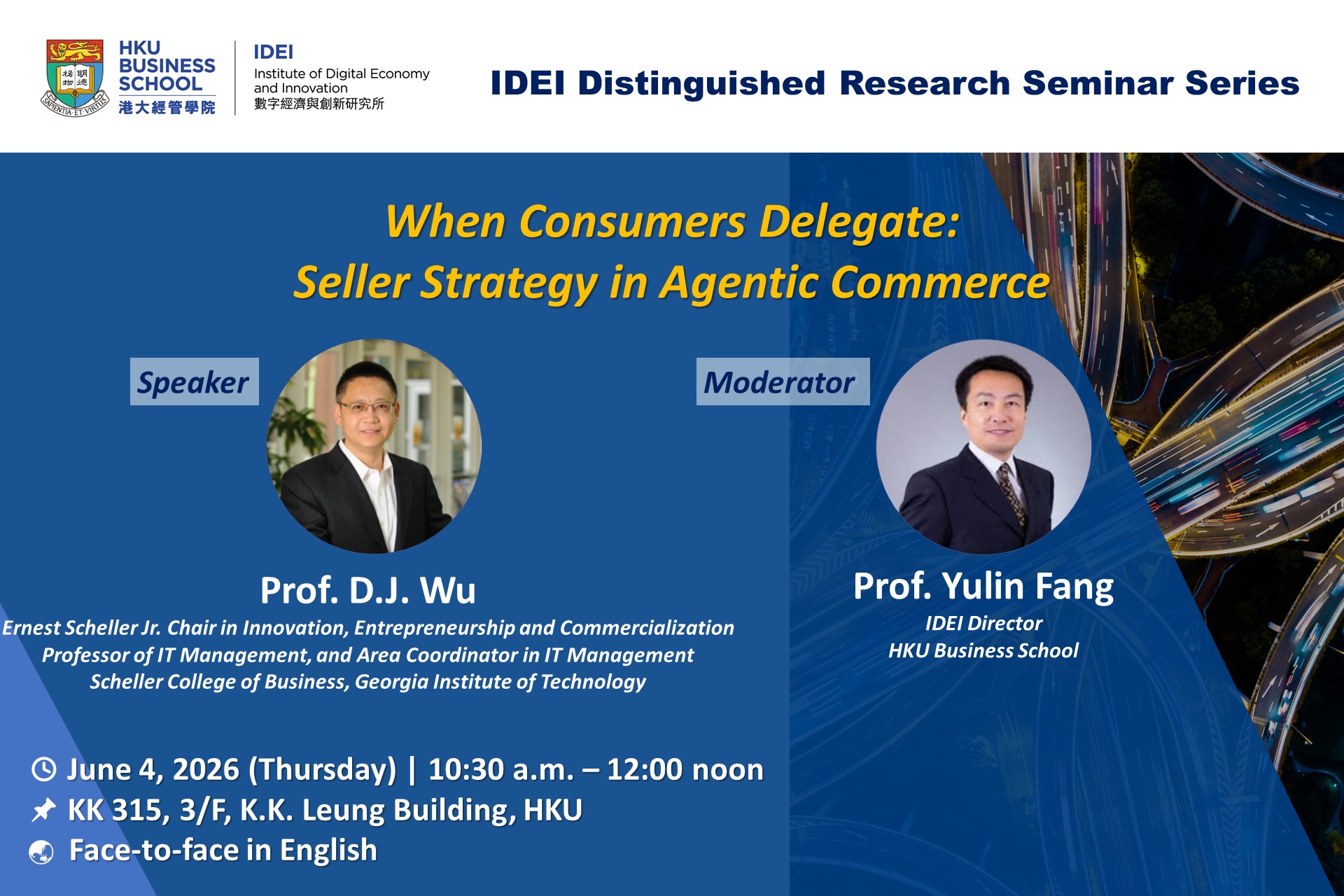
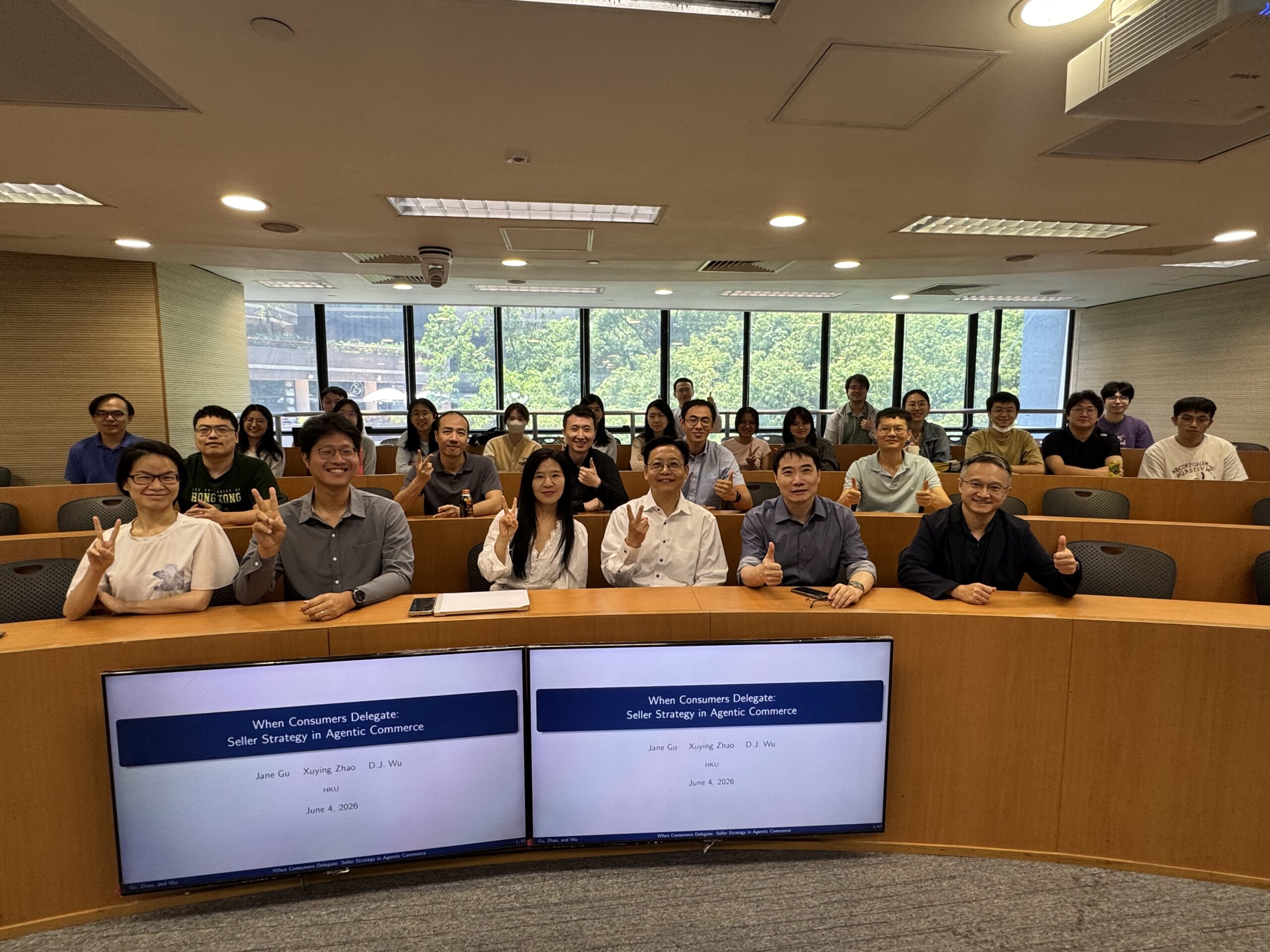
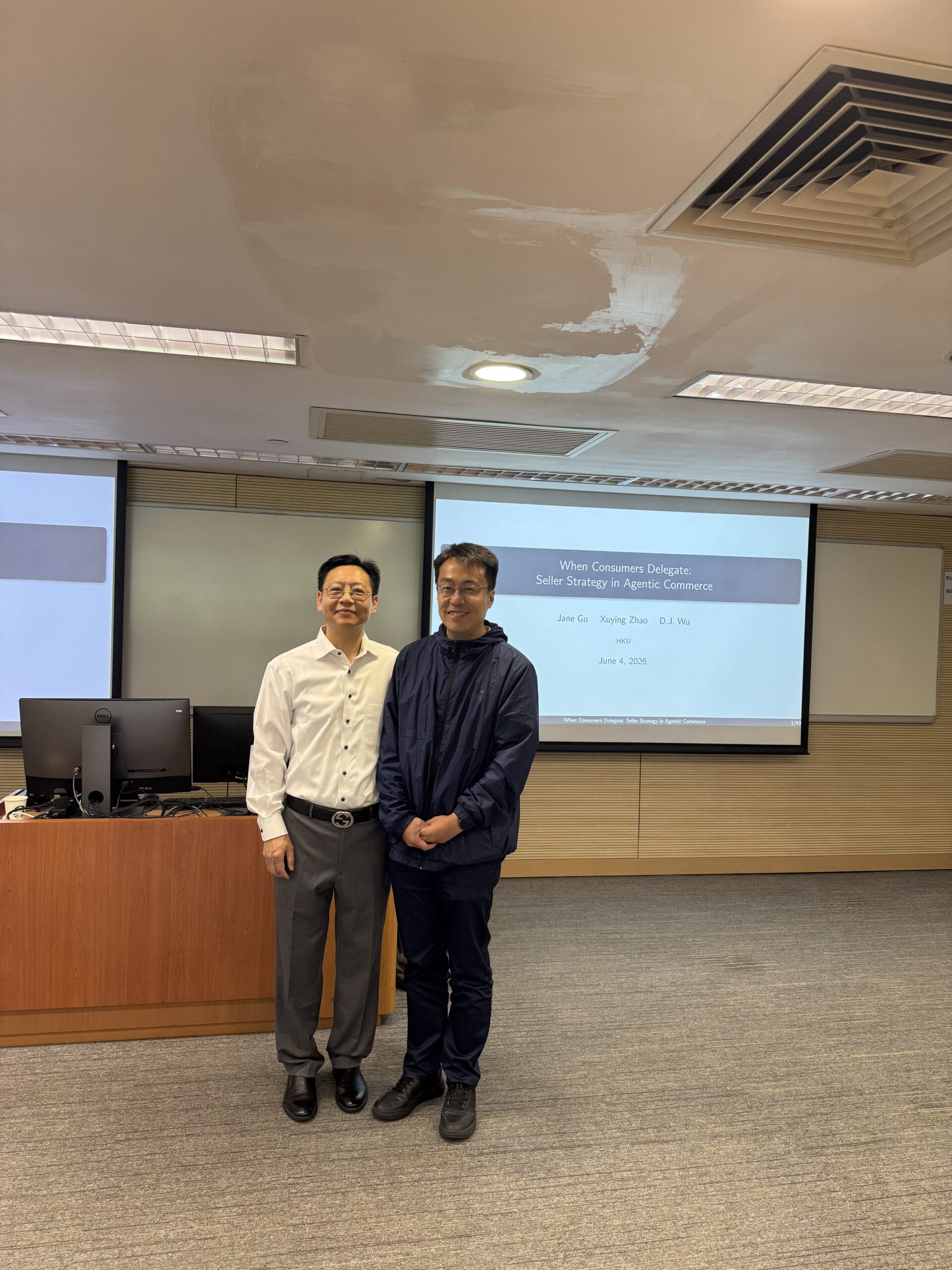
When Consumers Delegate: Seller Strategy in Agentic Commerce
June 4, 2026 | 10:30 a.m. — 12:00 p.m.
KK 315, 3/F, K.K. Leung Building, HKU
Face-to-face in English
No registration required
SPEAKER
Prof. D. J. Wu
Ernest Scheller Jr. Chair in Innovation, Entrepreneurship and Commercialization
Professor of IT Management, and Area Coordinator in IT Management
Scheller College of Business, Georgia Institute of Technology
SPEAKER
Prof. D. J. Wu
D. J. Wu holds the Ernest Scheller Jr. Chair in Innovation, Entrepreneurship, and Commercialization. He is a Professor of IT Management and the Area Chair of IT Management at the Scheller College of Business, Georgia Institute of Technology. He earned his undergraduate degree in Computer Science and Technology from Tsinghua University and obtained his Ph.D. from the Wharton School, University of Pennsylvania.
Dr. Wu’s research interests include the economics of digital innovation and transformation, digital business model innovations, platform ecosystems, enterprise information technology, and artificial intelligence and machine learning. His recent work has been published in leading academic journals such as Management Science, Information Systems Research, Manufacturing and Service Operations Management, MIS Quarterly, and Production and Operations Management. In 2023, he was recognized as a Distinguished Fellow by the INFORMS Information Systems Society.
Currently, Prof. Wu serves as a Department Editor for Information Systems at Management Science. He is also a Co-Editor for the Management Science Special Issue on the Human-Algorithm Connection and the Special Issue on Analytical Creativity at Information Systems Research. Previously, he served as a Senior Editor for Information Systems Research (2018–2020) and as President of the INFORMS Information Systems Society (2019–2021).
ABSTRACT
AI shopping agents increasingly automate consumers’ product shopping journey, threatening the effectiveness of traditional marketing strategies such as advertising and search engine optimization (SEO). This study examines a seller’s strategic response when consumers switch from its direct-to-consumer (DTC) shopping channel (e.g., online stores) to AI shopping agents. Beyond pricing, the seller decides on the level of generative engine optimization (GEO), which increases the chance for its product to be recommended by the AI shopping agent. We obtain four main results. (1) The emergence of AI shopping agent motivates the seller to shift from a demand-oriented to a margin-oriented strategy, leading to higher product price and lower consumer surplus. (2) Consumer sophistication curbs a seller’s incentive to implement GEO for moderate- or high-quality products, even when implementing GEO is costless. (3) More consumers switching to AI agentic shopping (a higher AI delegation rate) motivates the seller to reduce the GEO level and increase price. (4) Sellers offering moderate-quality products benefit more from AI agentic shopping than those offering low- or high-quality products, revealing a “mid-tail” advantage.